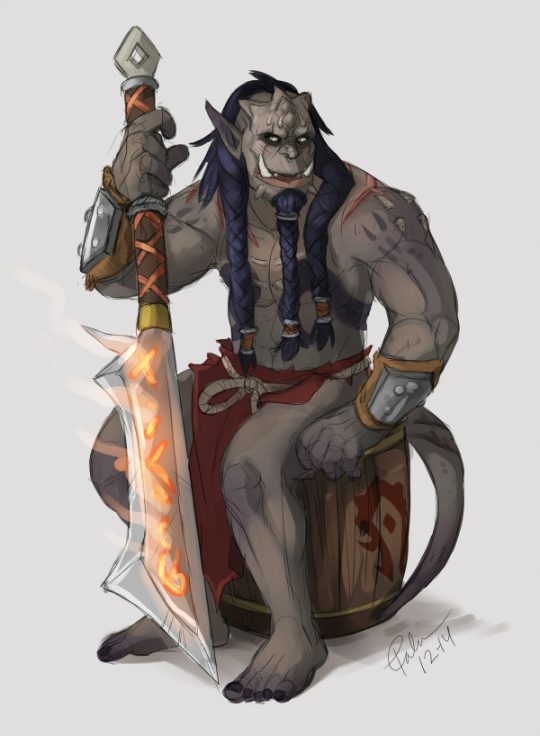
Lantresor the Blade is one of my favorite Garrison followers. I wish Blizzard would have made him a customized model, being that he’s half draenei and half orc. I am assuming that, being they used an orc model, he looks more orc than draenei. So I doodlescribbled my headcanon look for him.
Mmm blademasters <3
tmirai: Lantresor the Blade is one of my favorite Garrison followers. I wish Blizzard would have made him a customized model, being that he’s half draenei and half orc. I am assuming that, being they used an orc model, he looks more orc than draenei. So I doodlescribbled my
in case anyone (and i think a LOT of ppl aren’t yet aware) didn’t see the MASSIVE post i reblogged earlier this month, “bara” is actually more or less equivalent to a slur against gay men in japan, and NOT a cutesy term for buff men
so like, i’m not sure exactly how it became misconstrued as that over here but it’s probably best if ppl slowly weed it out of their vocabulary, because as white westerners (and esp. any white straight women) we really shouldn’t continue using a slur just because we understand it differently here
this isn’t a call-out either! i was using the term literally up until about a month ago when i read the post, and i’m a huge supporter of MASSIVE and the manga artists they promote so i just think, y’know, it merits a reminder
So the person who posted the original article, actually says it’s a bit more complicated than this.
hornedfreak: I have no idea what the heck is going on
My guards are assholes This is perfect.

My guards are assholes
This is perfect.
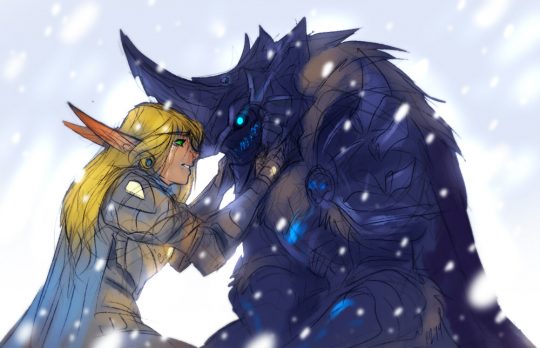
pyxuspie: blencem: Full color commission for Pyxuspie, an early christmas present for Pujface.Hope you both like it! They were a real delight to draw ; u; Look at this godly coloring. I am in love with this piece and you already know it, I don’t care for I will proclaim my
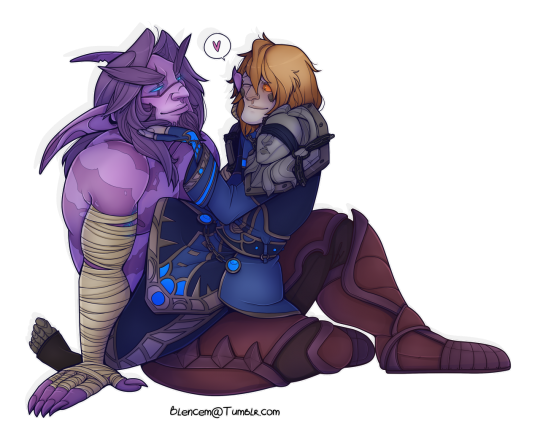
Full color commission for Pyxuspie, an early christmas present for Pujface.
Hope you both like it!They were a real delight to draw ; u;
Look at this godly coloring. I am in love with this piece and you already know it, I don’t care for I will proclaim my love for it again! This is amazing <3
Every little detail of the gear is perfect, you’ve taken a complicated set and mastered it. I love how you drew the stone, those metal embellishments, the shiny blue jewels and so much more!
Plus look at that fuzzy grump actually cracking a smile. ;w; I love this so much and just wow, thank-you so much for drawing these two. You did an amazing job.
hello. i’ve seen the commentary you’ve made regarding the term “bara” and i would like to know if this term is considered inappropriate to use in light of that information? i’ve noticed some people are already denouncing it, and considering this is tumblr, there’s a high chance of people that will call out or personally attack others that still use that term because they aren’t as informed
“Bara” isn’t worth starting a Tumblr social justice war over. It’s a loanword with a complicated history both in Japanese and English, and a plethora of usages. At best it unites fans with a common interest in the type of art posted on this blog, and at worst it’s a culturally insensitive misnomer.
I would say maybe it’s inappropriate to use it in a sentence like “Gengoroh Tagame is my favorite bara artist,” because that’s not how he identifies. However, the Japanese artists we’ve discussed it with seem more perplexed by its usage than oppressed. It’s an antiquated word there, most strongly associated with the old Barazoku magazine, but it doesn’t connect with modern gay culture.
There’s a long history of Western misappropriation of the Japanese language, so I’m striving to be mindful of that (after using the term “bara” myself for years). This is a nation that calls itself “Nihon” (日本), and we’re still calling it “Japan” 700 years after Marco Polo’s misinformed assertion that the region was named “Cipangu.”
More recently, and with more than a few parallels to the subject at hand, the term “yaoi” came into popular use internationally for the manga genre that Japanese artists mostly refer to as BL (Boy’s Love). These days, artists all over the world are making work they proudly call “yaoi,” and that’s great. If they identify with the term and find what it represents to be empowering, how can you hate on that?
It’s not just a one-way street, either. Japan’s own sexual categories have both influenced and been influenced by Western terminology. Even the word “gay” (ゲイ or gei) has had its own unique trajectory in Japan since it was introduced during occupation following the Pacific War. It became a widely used term in Japanese culture decades before the word “gay” was well-known in the U.S.
From Mark McLelland’s great book, Queer Japan from the Pacific War to the Internet Age:
Indeed, “gay,” as a signifier for homosexual men and women, was not widely understood even in the United States in the 1950s. The term established itself as a common referent among homosexual subcultures in the United States only as a result of the mass mobilization during the war, which brought a diverse number of homosexual men and women together from all parts of the country and helped standardize gay slang.
[…] Compared with the slow dissemination of the word “gay” throughout anglophone societies, where it was to take another 25 years before becoming general currency, the rise of gei in Japanese was meteoric. Gay (gei) entered Japanese immediately after the war via gay men in the occupation forces, who referred to their Japanese partners as gei boi or “gay boys.” By the 1950s gei, especially as part of the compound gei boi, was being used in the Japanese media to describe effeminate homosexual men.
The meaning of gei originally didn’t quite match up with the American usage of “gay.” It referred specifically to homosexual men (never women) “who displayed transgender characteristics or worked in the entertainment industry.”
The term gei continued to evolve in Japanese usage over the following decades, and by the time the Japan experienced a cultural “gay boom” in the early 1990s, the meaning of gei had grown closer to the newly globalized “gay,” as LGBT activism surged around the world. However close gei has become to “gay,” there’s still an important distinction. When I talk about gay manga, I’m always really talking about gei manga.
Anyway, I’ve gone off on a few tangents here, but this is all to say that the terminology of sexual minorities is often contentious and frequently shifting, and in the case of “bara” it’s complicated further by the tides of cross-cultural exchange.
For more reading on the many complex ways in which language has shaped understandings of sexuality in Japan, I highly recommend reading the above-mentioned Queer Japan, as well as Katsuhiko Suganuma’s Contact Moments: The Politics of Intercultural Desire in Japanese Male-Queer Cultures and Gregory Pflugfelder’s Cartographies of Desire: Male-Male Sexuality in Japanese Discourse 1600-1950.