i’ve definitely told you about this before but my dad and my uncle have this whole star wars vs star trek rivalry where they’ll get each other passive aggressive gifts (my dad is a star wars fan, and will always get my uncle star wars merch. my uncle claims star trek is so much better and star wars is lame. he will always get my father star trek merch. this has been going on since my parents got married.)
this is going to be a good year for arguing
my uncle just arrived. my mom shouted “kids, uncle rich is here!” my dad bellowed “MAY THE FORCE BE WITH YOU” down the stairs. my uncle shouted back “YOU CANT SEE IT BUT IM GIVING YOUR DOG THE VULCAN SALUTE” i love christmas here
dinner was alright until over dessert my dad brought up “so, richie, you see the new star wars movie” until it devolved into a wine fueled shouting match. highlights include “WELL AT LEAST WE DIDNT HAVE JAR JAR GODDAMNED BINKS” “AT LEAST WE DIDNT BLOW UP–” “YES YOU DID. FIRST MOVIE. YOU BLEW UP A PLANET” “shit”
makkochi: here’s a work in progress!shush, quiet words, battle babe sleeps

literalprush: fave dks @tevruden @doodlejinx Look at these nerds tho




dundeey: wuqs: dykelapis: mate i’ve been on this website since 2010 and in five years i’ve never been more offended than seeing banana bread labeled ‘shit tier’ fuck this image, man. literally fuck everything about this. this person does NOT understand bread. one,
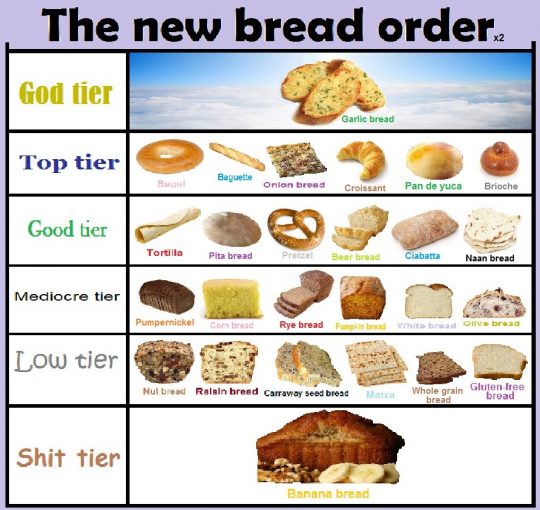
wuqs:
mate i’ve been on this website since 2010 and in five years i’ve never been more offended than seeing banana bread labeled ‘shit tier’
fuck this image, man. literally fuck everything about this. this person does NOT understand bread. one, those top tier bread images are literally the worst examples of those types of breads. that baguette fucking pains me deep in my SOUL. and real croissants, good ones, rarely look like that if they’re going to be properly flaky and delicious. and that bagel looks like it was made in a factory thirty years ago, preserved with fucking like latex or some shit what the hell
but the worst, the most heinous of all crimes, is putting banana bread as shit tier? are you serious? have you had banana bread? have you EXPERIENCED it? you have it below fucking wonderbread-looking shit, below onion bread, and below a loaf someone haphazardly shoved fucking nuts in? banana bread loves you. banana bread sees that you bought too many bananas, that they’ve been sitting on your counter starting to get a little too ripe and says, hey, you know what it’s okay, we all buy a few too many bananas sometimes, why not whip up some of me, good ole banana bread, and i’ll be a sweet little treat, maybe a breakfast or a neat snack.
fuck you. fuck you and your abhorrent ignorance of breads. i bet the best garlic bread you’ve had is from fucking olive garden you sack of reprehensible shit flakes
bread fandom grab your bread
I FUCKING HATE WHEN PEOPLE POUR KETCHUP ALL OVER THE FRENCH FRIES INSTEAD OF A DESIGNATED CORNER AND THEY OFFER ME SOME LIKE NO FUCK YOU AND YOUR TAINTED FRENCH FRIES
rincewitch: allthingslinguistic: The New Shortest Science Paper Real Clear Science has pointed out a clever example of the shortest possible academic article. It’s called “On nonrecoverable deletion in syntax,” and was published in 1972 in Linguistic Inquiry. They
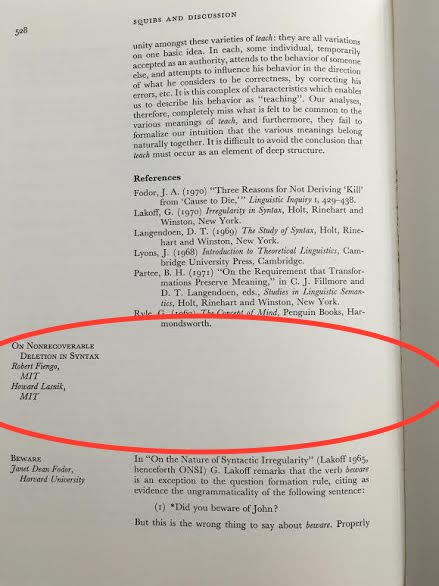
The New Shortest Science Paper
Real Clear Science has pointed out a clever example of the shortest possible academic article. It’s called “On nonrecoverable deletion in syntax,” and was published in 1972 in Linguistic Inquiry. They quote University of Texas associate professor John T. Beavers, who sent in the image above with an explanation:
The 1960s and 1970s saw a growth of work on the syntax of natural languages due to the groundbreaking work of Noam Chomsky, who began a research program known as Generative Grammar that sought to describe and explain the knowledge speakers have of their native languages through explicit formalization and hypothesis testing. One phenomenon that has received attention is ellipsis, i.e. when words are left out of a sentence but the information that is unexpressed is still inferred semantically. An example is “verb phrase ellipsis” where the main verb phrase of a clause is left out, as in the second clause in “John will be here tomorrow but Mary won’t.” In the given context it’s clear that there’s an implicit “be here tomorrow” after “won’t”.
One way of analyzing this is to assume that in some underlying mental representation of the sentence the verb phrase “be here tomorrow” is actually present after “won’t” (accounting for the fact that that’s how we interpret it), but its overt phonetic form is deleted when uttered because the information is recoverable from earlier in the same sentence (the previous mention of the verb phrase “will be here tomorrow”, the antecedent of the ellipsis). It had furthermore been hypothesized that deletion in syntax of this sort could only ever happen if there was an explicit antecedent, a rule of grammar called the Recoverability Condition on Deletion, first proposed by Jerrold J. Katz and Paul M. Postal in 1964 and developed by others later. It had a lot of intuitive appeal — what would it mean to leave out something while giving no clue as to what you left out?
Then, in 1972, Linguistic Inquiry published the Fall issue of its 3rd volume, and on page 528 was a paper called “On nonrecoverable deletion in syntax” by Robert Fiengo and Howard Lasnik on exactly this topic. Indeed, some people who saw the title might have thought, “Ah! Somebody found an instance of nonrecoverable deletion! Unexpressed material without an antecedent! A violation of the Recoverability Condition! I wonder how that works.” In fact, that’s exactly what I thought in 2002 as a grad student when I stumbled across the title. I quickly ran to the library to get the journal out, and I flipped it to page 528 to begin reading.
It was instead a clever joke, and a striking argument in FAVOR of the Recoverability Condition.
The point of the article was to argue for the recoverability condition by violating it in a rather spectacular (and cheeky) way, thus demonstrating the effect.
lmao i’m glad the archives of linguistic inquiry i’ve had to go through for work don’t go back to 1972 or else i probably would have flown into a panic trying to find the text of this paper because clearly it’s missing from our site for some reason