this reminds me of the time I visited Canterbury Cathedral and a nice old volunteer told me all about the grooves worn in the floor from pilgrims kneeling there
Things like this don’t just reflect the past, they also shape the future.
When Rome was building its network of roads, it was also using war chariots with wheels a standard size and distance apart. The chariots wore deep grooves into the roads that were essentially the same everywhere. Because of these ruts, everyone pretty much always made wagons and other wheeled vehicles with wheels that fit into them so they didn’t have one wheel slip into one and crack the axle. This just sort of became The Size Vehicles Are, so train tracks have their rails match these dimensions too. A lot of train lines pass through tunnels, and these tunnels are of course built just large enough to accomodate the trains. These train lines, with the tunnels, are pretty much the only reasonable way to move very very large cargo overland.
When we build space ships, we didn’t build everything at the launch pad. Parts had to be constructed all over the place. These parts then had to be moved for assembly. That means that had to be put on trains. That means they had to fit in the tunnels, which were sized based on trains, which were sized based on their rails, which were sized based on the exact dimensions of war chariots of the Roman Empire.
And that’s how the grooves worn into roads by Roman soldiers two thousand years ago determined real physical properties of space craft.
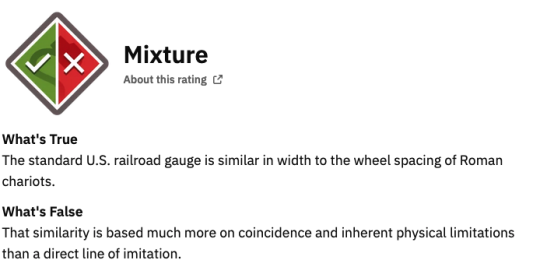
This is a very beautiful story but it does not make it a true story
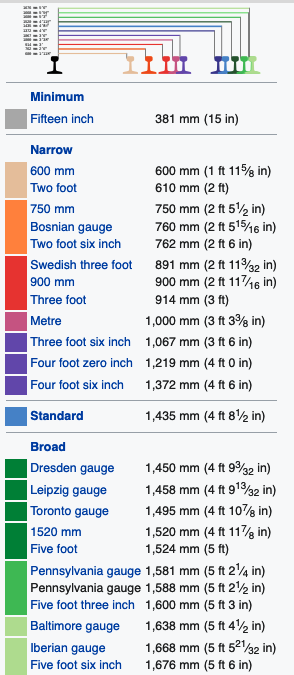
Railroads have had LOT of gauges:
The standard gage was close to historcal and a happy-enough medium that it became standard for “trivial and unremarkable reasons.” i.e: “The historical tendency to place the wheels of horse-drawn vehicles approximately 5 ft (1,524 mm) apart probably derives from the width needed to fit a carthorse in between the shafts“