Deliberate omission of grammar to show e.g. defeatedness, bewilderment, fury. As seen in Tumblr’s ‘what is this I don’t even’.
‘Because [noun]’. As in ‘we couldn’t have our picnic in the meadow because wasps.’
Use of kerning to indicate strong bewilderment, i.e. double-spaced letters usually denoting ‘what is happening?’ This one is really interesting because it doesn’t really translate well to speech. It’s something people have come up with that uses the medium of text over the internet as a new way of communicating instead of just a transcript of speech or a quicker way to send postal letters.
Just the general playing around with sentence structure and still being able to be understood. One of my favourites of these is the ‘subject: *verbs* / object: *is verb*’ couplet, as in:
Beekeeper: *keeps bees* Bees: *is keep*
or
Me: *holds puppy* Puppy: *is hold*
I just love how this all develops organically with no deciding body, and how we all understand and adapt to it.
Man but the current usage of “is that a thing?” is not just standing in for “does that exist?” or it wouldn’t be nearly as interesting. It can, depending on context mean:
“Is that a thing (that exists)?” “Is that a thing (that people do)?” “Is that a thing (that’s considered normal)?” “Is that a thing (that’s possible)?” “Is that a thing (that’s significant)?”
In a lot of cases “a thing” is standing in for the much more archaic phrasing “the done thing”, as in “is bringing host gifts to a summoning ritual (the done thing | a thing)?”
And that’s interesting in and of itself but it also encompasses all those other meanings with very few miscommunications. Despite the multipurpose phrasing we almost always understand what someone is asking when they ask if something is a thing, and that’s *really cool*
Oh man! This is
a question artists have to deal with all the time, and it’s hard to draw a
clear line in the sand. I usually think about it like this: would you
feel guilty if someone tracked down your source material and called you out on
it? If that’s the case, you proooobably want to dilute your reference
library a little more.
You generally want to saturate your brain with your reference, allowing you to really understand the structure and dynamics of
the thing you’re drawing – not just mimicking exactly what you’re seeing on the
flat picture plane. You’ll get a pretty good drawing of folds/draping
fabric if you copy a single reference photo, sure, but I can almost guarantee
that working from several similar (but different) photos means that you’ll end
up with something far more original – and, bonus, you’ll probably understand
more about the reference material in the process.
I have a ton of reference open on my other screen for a jacket I happen to be painting for work – some
of it has the angle I need, some of it hints at the lighting, but a lot of it
is just there to help me understand the structure of a tailored jacket and how
it moves on the human body. I may be drawing the arms down, sure, but seeing how a sleeve shifts when it’s raised in the air helps me understand how the armscye fits into the trunk of the
jacket! Super valuable stuff, even if you wouldn’t thing so at first blush.
As for drawing from designer clothing, again,
be thoughtful about it! If you’re drawing your character in street clothes for a comic, sure, go for it. If you’re trying to pass something off as
an original costume/character design, or if the dress itself is an integral part of your illustration, then I’d probably reconsider. You definitely don’t want
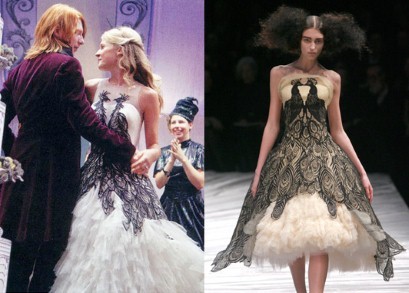
to go down in history as the artist who blatantly copied a McQueen gown for
Fleur Delacour’s wedding dress:
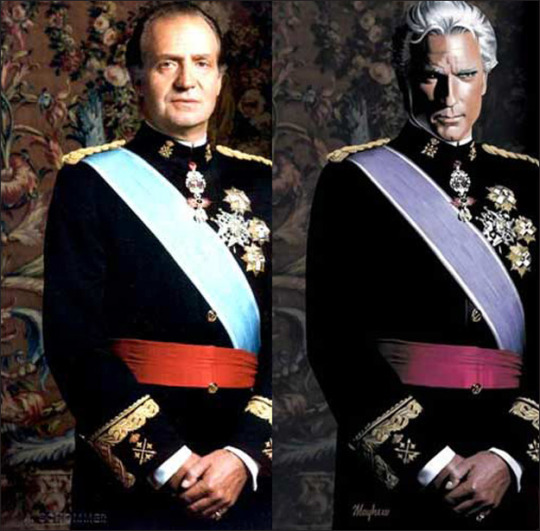
…ooooor the guy who upset the King of Spain when
he turned him into Magneto for a House of M cover:
…Just sayin’.
This is probably the best description of using clothing reference that I have heard in ages.